.svg)


%20(2).webp)



9:41 PM on a Thursday in India. I'm out with friends when my phone buzzes with a WhatsApp message from my manager. As it often does. This time though, instead of replying, I do something rebellious.
I reply to a late-evening message the next morning.
My “courage” wasn’t even intentional (may have been fueled by certain liquids). I had a long day, and honestly, the query could have waited. Most things can.
I was reprimanded for replying to said late-evening message the next morning.
The words didn’t sting as much as the subtle message: I was available; you weren't. An unspoken disappointment lands on the people-pleaser. My silence signaled unavailability (fair), distance (okay), even disrespect (wait, what?)...
Fast forward a bit, and I’m in Denmark. I get a similar late-evening message, one that is incredibly unusual here. I type out a response. Delete it. Type again. My thumb hovers over send.
Before I decide, another message arrives: "Sorry about the late message, reply at a convenient time."
No disappointment, no conversation about availability, no subtext to decode. The boundary wasn't questioned because it didn't need explaining.
Same boundary. What changed?
The Invisible Architecture
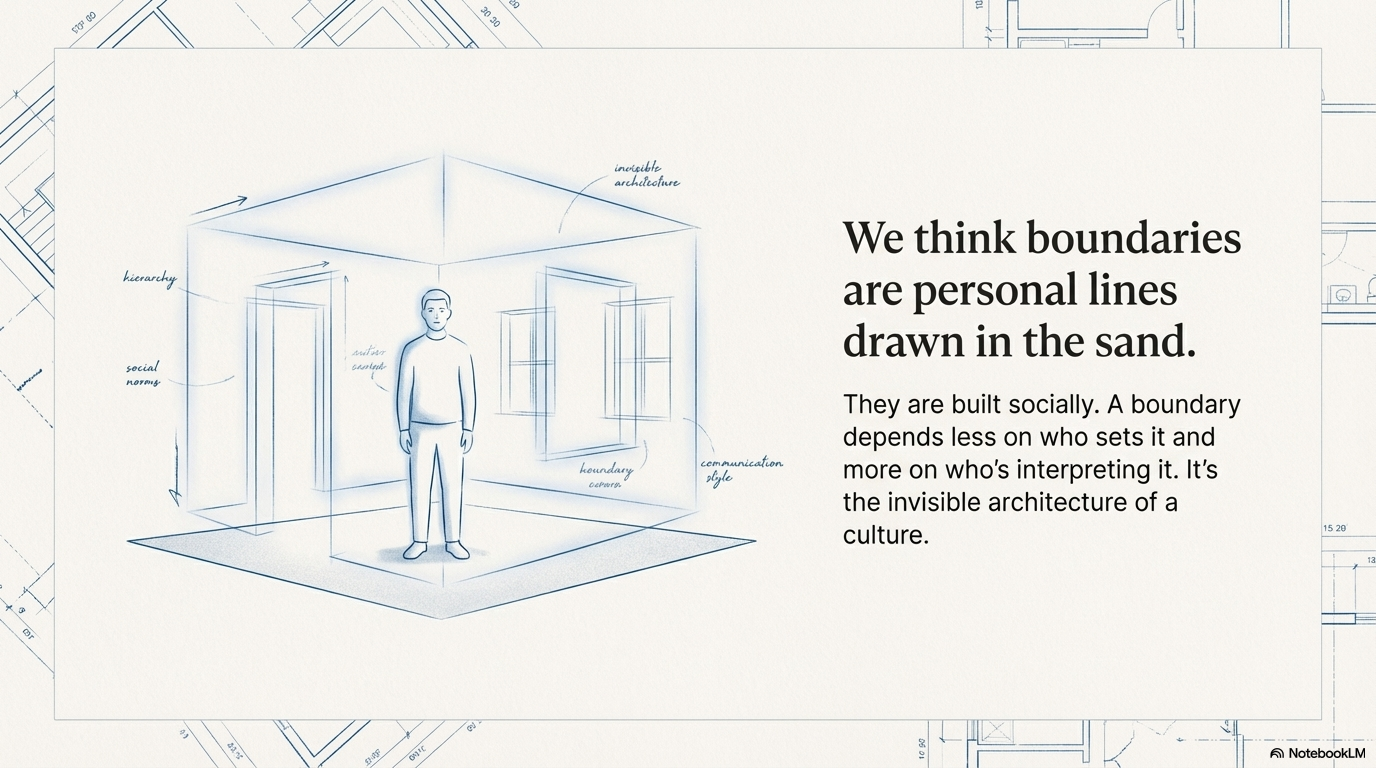
We talk about boundaries like they're personal lines you draw in the sand. Most discourse around them is rather individualistic too:
- "Protect your time."
- "Say no without guilt."
- "Communicate clearly."
Solid advice, but we live in a society (yes, meme reference). Boundaries are built socially. The sand of Juhu Beach also differs from the sand of Brighton beach.
Boundaries are personal choices heavily influenced by cultural inheritances. They are shaped by power structures, communication norms, economic safety nets, and the stories each society tells itself.
Lots of big words. In a nutshell?
A boundary depends less on who sets it and more on who’s interpreting it. Silence, for instance, can read as healthy, unprofessional, assertive, rude, or admirable depending on the culture you’re standing in.
So, to understand boundaries, you have to look beyond the person. Peek at the culture, the invisible architecture that decides what a boundary means before anyone opens their mouth.
Three Lenses
Everyone loves a good three-part framework. Consultants. Copywriters. Me, apparently. After living across cultures, 3 lenses kept appearing:
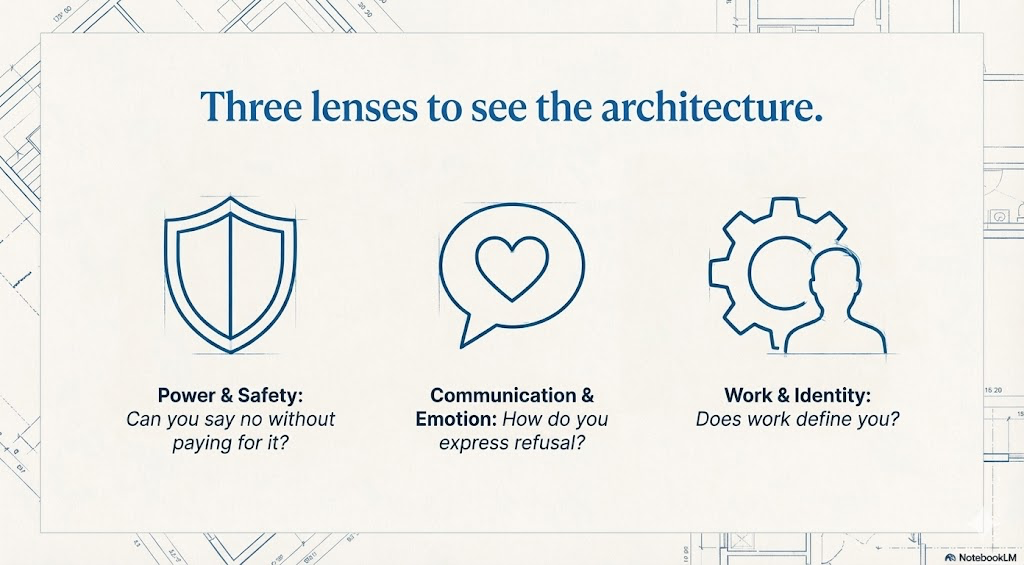
Power & Safety: Can you say no without paying for it? Steep hierarchy and job insecurity make boundaries dangerous. Flat structures and strong protections make them default.
Communication & Emotion: How do you express refusal, and what does it cost you emotionally? Direct cultures treat "no" as neutral information. Indirect cultures wrap it in apology and carry the guilt for days.
Work Beliefs & Identity: Does work define you, or is it just part of your life? When work is identity, boundaries feel like betrayal. When work is separate, boundaries feel like common sense.
Let me show you how these play out.
Denmark - Where Saying No Needs No Explanation
Offices empty out long before the sky turns orange. By 5 PM, desks are abandoned, laptops asleep, chairs tucked in neatly as if the workspace itself has decided it’s done for the day. Overworking means either the system failed or you did. Intruding into someone’s non-work time is treated with the same seriousness as interrupting a family dinner. You better have a solid reason. The best part is nobody tries to impress with extra hours.
Time is communal and so are its boundaries.
Power & Safety
Janteloven. Denmark lives by this little social code which places a huge emphasis on collective accomplishments and well-being. Rule 6 states “Do not think you are more important than we are.” Imagine telling that to your manager. (DON’T!). It then comes as no surprise that workplace hierarchy is low. Power is distributed. A junior freely says “I can’t take this today” without fearing how they’ll cover next month’s rent.
The Danish labour market operates on a "flexicurity" model, which combines workplace flexibility for companies (easier hiring and firing) with a strong social safety net (generous unemployment benefits). From unions to policies, the system has your back, come what may.
Boundaries aren't defended because they're assumed.
Communication & Emotion
Danes communicate directly. Directness is a way of showing you value the other person's time and intelligence by not beating around the bush. So, when a Danish colleague says, "I can't do that, I have plans," they mean exactly that. There is no cushioning. Saying no doesn't rupture the relationship because you are respecting the other person. Can’t get mad at that, no?
Boundaries carry no shame because they carry no emotional weight.
Work Beliefs & Identity
The national concept of hygge (coziness and contentment) emphasises enjoying life's simple pleasures. Work, erm, tends to fall flat compared to cozying up with a good book. Life outside work holds primacy. Companies know it too, so your productivity is measured in outcomes and presence means nothing if the work isn’t done well. You get a fun paradox. One of the world’s most productive countries actively prioritises work-life boundaries. There may be a lesson here. Your work is just something you do, not who you are.
Boundaries are necessary.
UK - Where Saying No Speaks in Code
Work winds down gently in the UK. Someone stands up and says a soft “Alright, I’m off then,” which is less an invitation (internally they’re praying nobody stops them from going home) and more a model of how to leave without disrupting the room. Work is over. Let’s not make a fuss. Refusing extra work doesn’t involve a hard boundary. It comes with a phrase like “Might be tricky today,” or “Shall we revisit this next week?”
Boundaries exist, but they arrive disguised as etiquette.
Power & Safety
You can’t escape your roots, they say. The UK had them in the feudal and class-based systems. Of course, they’ve come a long way since then. Ergo, hierarchy is present but blurred by politeness. Boundaries become unsafe when stated too abruptly or without acknowledging the other person's needs first. Professional harmony requires careful navigation.
Boundaries are safe when delivered politely, professionally, with the right tone.
Communication & Emotion
According to a Trinity College London research, 50% of Brits use something called polite-isms in the office. Think of it like saying “No rush!” when you want to say “THE DEADLINE WAS YESTERDAY!” British communication, you see, is indirect. The same research reports that 83% of the respondents actively try to avoid confrontation entirely. Soft no becomes a culturally fluent skill. You signal unavailability without ever saying the word "no." Conflict is avoided through your choice of words.
Boundaries survive through linguistic diplomacy.
Work Beliefs & Identity
Work ethic is measured by composure. You’re expected to handle a lot without looking flustered. Yes, presence culture may still echo in older institutions, but it is not the priority. What matters most is getting the job done. Unless it’s 5:01 PM on a Thursday. Then, you head out for cheeky pints with your work colleagues, who see you inhale beers. Talk about a blurry boundary.
Boundaries are a side-effect of professionalism.
US - Where Saying No is Conditionally Fine
Americans say no with the confidence of people who believe time can be managed like a spreadsheet (maybe because they do). Boundaries are personal operating manuals. Everybody has their own, nobody expects them to match. Saying no, then, becomes a workload decision. You decide what you take on, what you push back on, and when you sign off. As long as you deliver, you’re trusted to decide where your time goes. You are an adult after all.
Boundaries become productivity and performance decisions.
Power & Safety
Puritan work ethic runs strong in the US. There’s a long religious history, but the core tenet is that your work is your primary life purpose. Hustle culture is a natural fallout. Hierarchy exists, but autonomy is the real currency. You’re hired for your judgment, so using it (including saying no) is part of the job. Don’t say it too much though. Work hard, get the job done.
Boundaries are safest when they align with productivity, ambition, or results.
Communication & Emotion
American communication is direct...sort of. You’re free to speak your mind. Honesty and open disagreement beats theatrics. Tell it like it is. Low-context communication. The emotional tone is friendly, enthusiastic even, but the boundary is there. Saying no is acceptable as long as you're hustling toward something bigger.
Boundaries don’t change feelings as long as they don’t change timelines either.
Work Beliefs & Identity
Good old American Dream. Work hard, and anything is possible. Work naturally becomes a site of self-definition. Hustle is admired, autonomy is expected. The culture encourages owning your limits but quietly rewards those who stretch past them. Someone else will, if you don’t.
Boundaries are allowed when they serve performance.
India - Where Saying No Feels Personal
Evenings stretch. A 6 PM meeting scheduled at 5:50 PM “for a quick minute” can easily spill past dinner. Post that, you get a 9 PM mail with an “urgent” task. Urgent, because the mail is by your manager. Urgency is measured by who asks and not what the task is. Are you dependable? Are you ambitious? Are you committed? Saying no means managing more than work. Nobody announces they’re done for the day because they rarely are.
Boundaries hover in the background, fragile and constantly negotiated.
Power & Safety
Indian society has a high power-distance, meaning there is a greater acceptance of unequal power distribution and a more top-down approach to leadership. The British colonial administration, sadly, left its mark. Seniors hold authority, not just over work but over career trajectories, learning opportunities, and reputation. Add job scarcity and intense competition to the mix, and you see why refusal feels existential.
Boundaries feel like risks.
Communication & Emotion
Boundaries can't be stated bluntly. Even when saying no, you signal availability. The idea is to make it clear that the other person's need matters more than your boundary, for you feel the emotional burden of letting them down. The priority is to preserve the relationship.
Boundaries live in hints, laced with emotional tension.
Work Beliefs & Identity
Work is identity, ambition, and family pride rolled into one. Certain professions, like being a doctor, carry significant prestige. What you do becomes your social status. Simultaneously, India's labour market has always suffered from an imbalance between job supply and demand. You better keep doing what you do. Put the two together, and you get all sorts of complications. Take the “face time” complication. Staying late signals dedication, even if you spent the last two hours scrolling Instagram.
Boundaries are shaped by relationships.
Why This Matters?
Okay, cool cultural tour. So what?
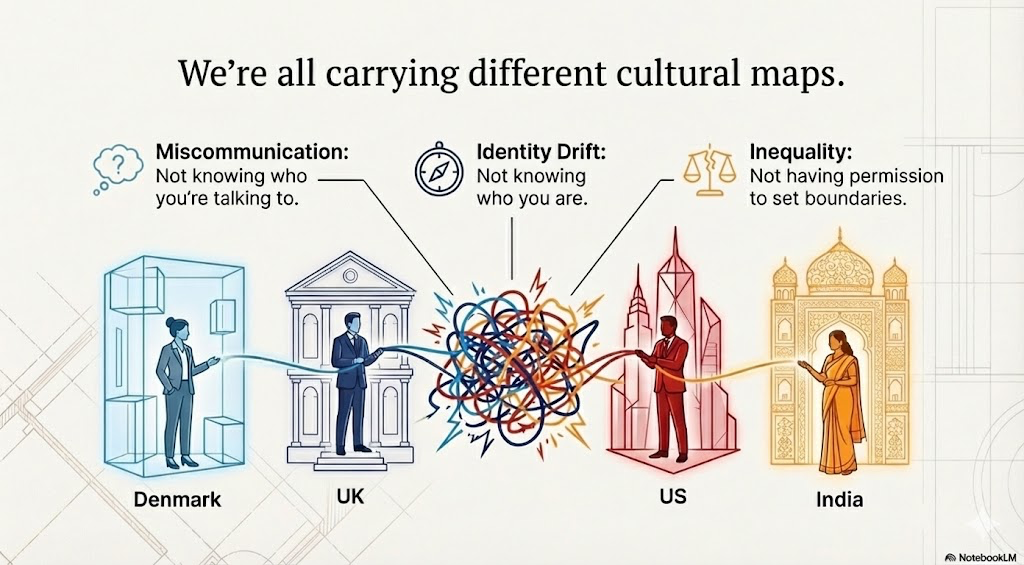
Well, for starters, we're all carrying different cultural maps. We keep setting (and crossing!) boundaries without realizing we're reading separate instructions. It's an honest mess.
Next, there's the inevitable identity drift if you hop cultures. Your sense of self and where your line is drawn constantly has to adapt to whatever system you're currently plugged into, meaning your boundaries can feel a little...fluid.
Finally, it’s cute to talk about boundaries as a purely personal choice, but that ignores the giant systems which pre-decide who gets the social permission to set them in the first place. Some folks are just born with more boundary-setting privileges than others.
The global boundary paradox results in not knowing who you’re talking to (miscommunication), not knowing who you are (identity drift), and not having the permission to set any in the first place (inequality).
Which poses an interesting dilemma….
Resolving The Paradox
Where do you draw the line between global cultural standards and local cultural norms?
You don't. You redraw it, constantly, depending on where you're standing and who's watching.
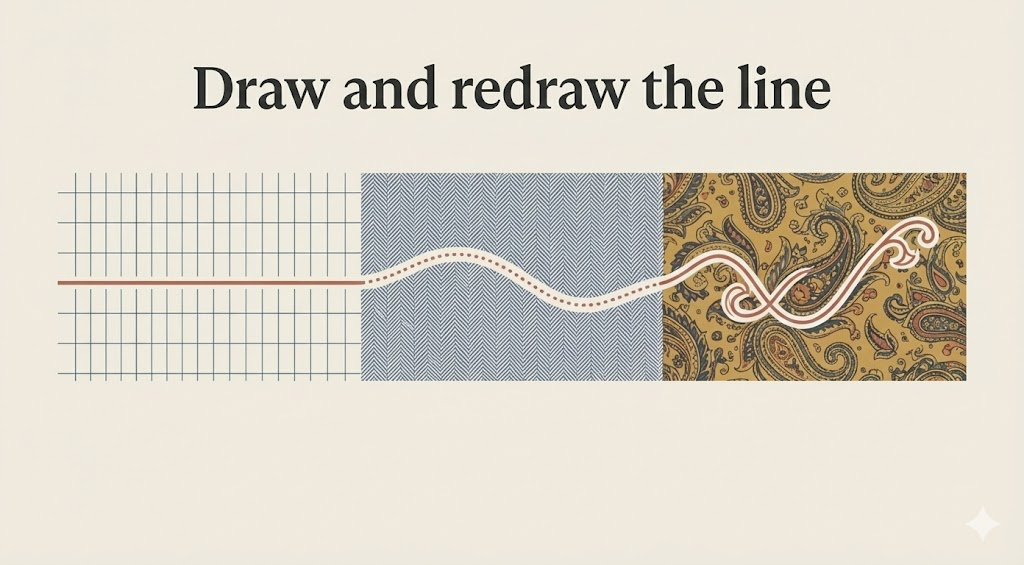
I still code-switch. In Denmark, I said no without cushioning. In the UK, I wrapped refusals in polite qualifiers. Now that I'm back in India, my old instincts return. You know, when in Rome…
Some things I won’t do as the Romans though. I value the integrity of my personal boundaries. This ensures I bring my real self to the table.
I suppose you learn to hold the paradox better.
When someone's boundary frustrates you, there's probably an entire architecture you're not seeing. When yours confuses them, the same is true in reverse. The instinct is to judge.
The harder move is to ask what does this mean in your world.
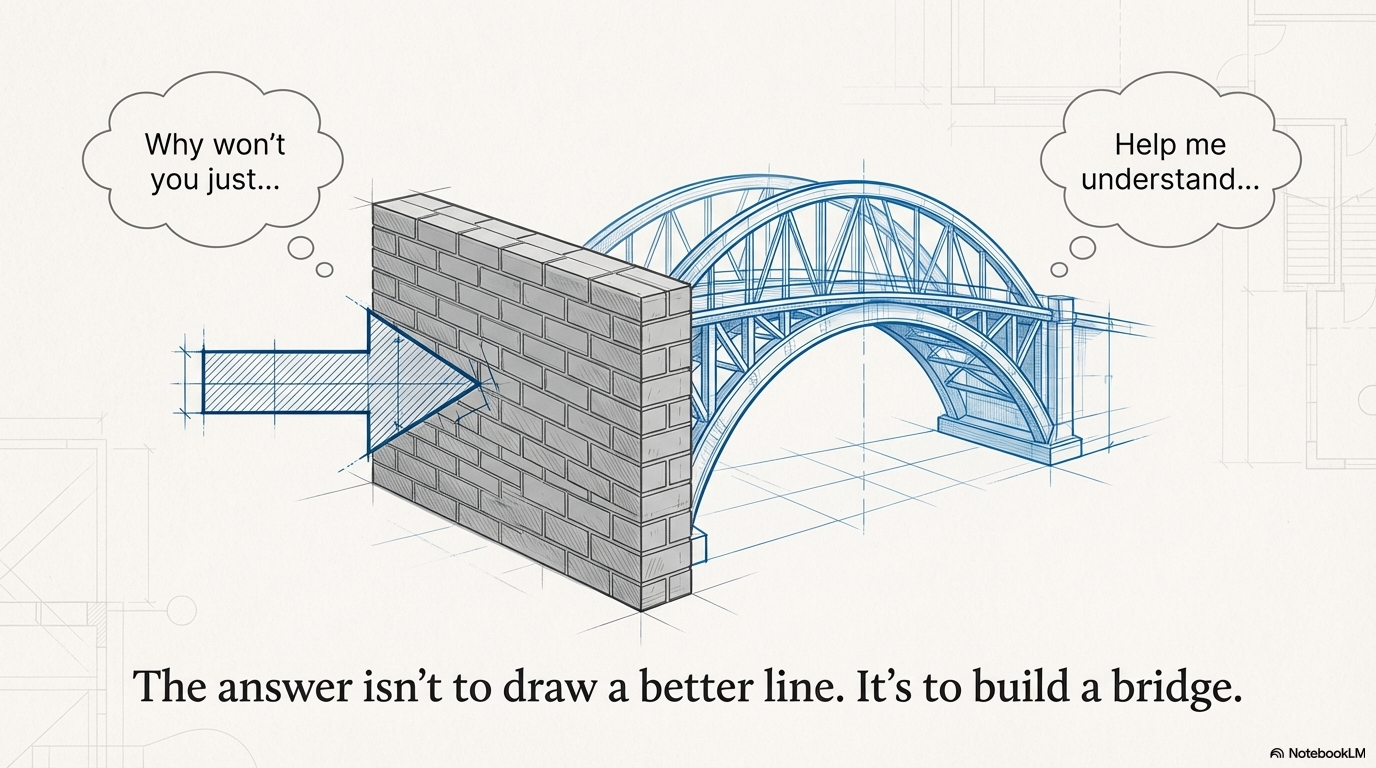
That question won't erase the power imbalances or undo centuries of cultural wiring. If only life were that simple. But it does change the conversation from "Why won't you just…" to "Help me understand."
And that understanding, that small act of seeing beyond your own wiring, is what makes work, and life, just a little more human.
EDITOR’S NOTE
The constant conflict of cross-country cultures is a fascinating topic to write about. It’s amazing how the individual is shaped by the collective, which is in turn shaped by larger sociopolitical and geographic narratives. Akshat’s piece is not merely a commentary on the unique working principles of different countries, but also a guide on navigating them.


.png)
.webp)

%20(1).jpg)
.png)


.svg)


