.svg)


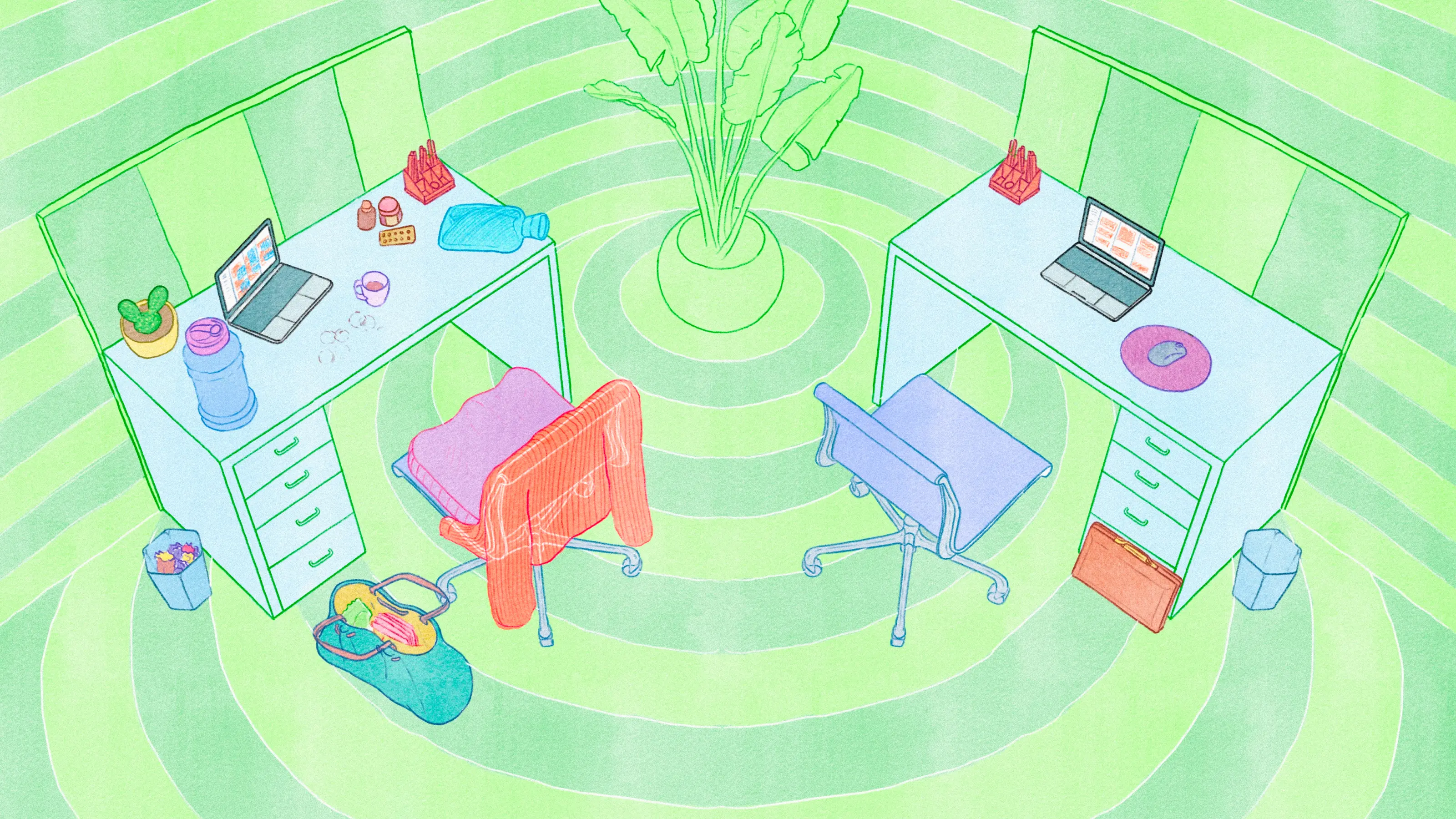


As I sit to write this piece, there’s a raging debate on news channels and on social media about the Supreme Court of India’s decision to dispose of a writ petition seeking a national menstrual leave policy. My uterus is raging too, as if in protest. I keep shifting in my chair, trying to find a position that makes the cramps tolerable enough to keep writing while those who’ve never had to experience them decide the rules of an equitable workplace.
Men in Power Discuss Gender Justice
Chief Justice Surya Kant has stated that mandatory menstrual leave would adversely impact women’s employability, that organisations will be reluctant to hire women.
Justice Joymalya Bagchi, the second part of the two-judge (all male) bench, said that affirmative action for women is constitutionally recognised, but questioned the practical reality of the job market. He observed that the more “unattractive” a human resource is, the less likely they are to be accepted in the market. Looking at it from a business perspective, he asked whether any employer would be happy dealing with the competing claims of other genders.
The CJI made another statement: such a policy would “create a psychological fear or impression among working women... that they are 'less' than men”.
They are not entirely wrong. In a capitalist economy, these policies have every chance to be viewed as detrimental to ease of conducting operations. Kerala State Road Transport Corporation, part of the public service sector, opposed the policy when it was proposed for its women employees, saying a menstrual leave policy could accelerate its insolvency.
Many employers may add this to the list of things that make a female candidate less ideal in their eyes.
But would a mandatory menstrual leave policy leave women feeling ‘less than men’? Or would it have employers and male peers seeing them as ‘less than’?
Your Full Self Is Welcome at Work. Just Not the Uterus.
The Supreme Court’s concern—that menstrual leave might make women less employable—rests on a flawed assumption: that women’s employability is currently neutral.
In reality, women’s employability has long been shaped by assumptions about their bodies: their periods, their pregnancies, their caregiving roles. The bias already exists. Policies do not create it; they merely expose it. The debate around menstrual leave is therefore not really about one policy. It is a snapshot of what it often means to be a woman navigating the workplace, where biological realities are quietly treated as professional liabilities.
You see it in the way many men dismiss menstrual leave as a “privilege”, sometimes with the smug suggestion that women who avail it should be willing to accept lower pay. The irony, of course, is that women are already paid less. India consistently ranks near the bottom globally when it comes to gender pay parity.
I’ve been in job interviews where the HR said with a straight face: “Oh you’re not married? What if you do after we hire you and you decide to have a child?” Married women friends tell me they’ve been rejected during interviews, on the grounds that they are a ‘risky’ hire, because there’s every chance that they will have a child right after they’re hired. Some of my friends saw a maternity policy formed only after they requested for one at their organization. And those that did go on mat leave, saw an uptick in micromanagement from their bosses. They also return to the workplace with a considerable spike in anxiety: they feel pressured to work doubly as hard to prove their skills and competence are intact, that motherhood hasn’t impacted them. This, on top of having to prove to the world they aren’t a bad parent for returning to work “too soon”.
These experiences may seem unrelated to the question of menstrual leave, but they reveal the deeper terrain on which such policies land. Workplace rules do not operate in a vacuum; they are interpreted and enforced by people, and by the cultures organisations cultivate. When women’s bodies are already treated as professional risks, any policy acknowledging those bodies will inevitably collide with the attitudes that shape everyday workplace behaviour.
Professionalism Is Important. Especially From Women.
The workplace likes to imagine itself as meritocratic, neutral. Patriarchy disagrees. The bias and conditioning always seep through. Organisations with high diversity scores report 45% increased innovation revenue, while organisations with low diversity scores have only 26% innovation revenue on average, according to a study by BCG. Yet DEI policies are resisted because implementing them is seen as betrayal of merit-based hiring.
Much of this bias persists no matter how progressive an organisation claims to be. Your male peer’s ideas are approved sooner, sometimes with less evidence to back them. You work twice as hard and arrive armed with data, yet you are asked to run your proposal past several stakeholders and gather their approval.
It becomes even more visible when women hold authority. Male managers and peers grow uncomfortable when you offer direct feedback. Men who report to you quietly undermine your decisions by double-checking them with another male leader. At one of my former workplaces, the HR manager casually told a group of young male employees over coffee that “women make for difficult bosses”. I was a “boss” sitting right there. The traits he described — strict, critical, distant — would likely be explained away with a “he’s having a bad day” if a male manager displayed them. The workplace simply holds women leaders to a different emotional standard.
Sometimes the gender bias is overt, as in the hiring and maternity stories above. More often, it shows up in smaller moments throughout the workday. You are asked to cut the birthday cake so everyone can have a piece. You become the default party planner; this now has a name: office housework. Well-meaning male colleagues hand you flowers on Women’s Day, not caring enough to understand what the day is actually about. Your male colleagues say “that guy” to refer to a fellow man, and “that female” if it’s a woman. Someone jokes that the woman in Sales attracts more customers, so perhaps the team should hire only women to hit the targets for the year. Call them out and they ask you to lighten up. Or, the next time they have a conversation around you, they need to dramatically let you know they’re “scared” to say anything in front of you.
One of my former colleagues managed a women-only team, and when he mentioned that he wanted to work from home more because he missed his 4-year-old daughter randomly walking in to hug and kiss him, a senior male leader responded: “Well, you have three girls on your team!”
While these behaviours range from revolting to merely irritating, they share one thing in common: men rarely have to deal with them, and men are usually the ones inflicting them. And as in so many other parts of life, women shrink to survive: only 28.8% of the total women in the workforce make it to management roles, according to the World Economic Forum’s Global Gender Gap Report 2025.
We learn to accommodate, to dismiss ourselves, to clench our teeth through the bias just to stay sane and keep going. Much like how many of us work through menstrual cramps, even though research shows the pain can rival that of a heart attack, because we don’t want a male peer sulking in the corner, calling it ‘female privilege’.
What you’ve read so far is a brief glimpse into what the workplace is like for women in tech. I often hear what it is like for women who are gigworkers, cook akkas, freelancers (they face larger pay gaps than full time employees), CAs, and lawyers. Each time, I come back feeling like I’ve had a smooth ride at work, in comparison.
Designing Workplaces That Work for Women
“If a factory is torn down but the rationality that produced it is left standing, then that rationality will simply produce another factory. If a revolution destroys a government but the patterns of thought that produced the government are left intact, then those patterns will repeat themselves.”
Robert Pirsig, Zen and the Art of Motorcycle Maintenance
Workplace debates often focus on policies: whether menstrual leave is practical, whether diversity initiatives are fair, whether flexible work arrangements undermine productivity. But policies alone rarely change the systems they are meant to reform. If the assumptions that shaped the workplace remain intact, those assumptions will simply reproduce the same outcomes in new forms.
Much of the resistance to policies addressing women’s realities rests on the idea that the workplace is fundamentally neutral. It isn’t. In her book Invisible Women: Exposing Data Bias in A World Designed for Men, author Caroline Criado Perez documents how the modern world—from medical research to urban planning to workplace policy—is routinely designed around male bodies and male life patterns.
Starting with the theory of Man the Hunter, the chroniclers of the past have left little space for women’s role in the evolution of humanity, whether cultural or biological. Instead, the lives of men have been taken to represent those of humans overall. When it comes to the lives of the other half of humanity, there is often nothing but silence”, she writes. She calls this the “gender data gap”: a world built for a default male user, where women’s realities appear as inconvenient deviations rather than ordinary facts of life: The gender data gap isn’t just about silence. These silences, these gaps, have consequences. They impact women’s lives every day. The impact can be relatively minor. Shivering in offices set to a male temperature norm, for example, or struggling to reach a top shelf set at a male height norm. Irritating, certainly. Unjust, undoubtedly. But not life-threatening. Not like crashing in a car whose safety measures don’t account for women’s measurements. Not like having your heart attack go undiagnosed because your symptoms are deemed ‘atypical’. For these women, the consequences of living in a world built around male data can be deadly.
One of the most important things to say about the gender data gap is that it is not generally malicious, or even deliberate. Quite the opposite. It is simply the product of a way of thinking that has been around for millennia and is therefore a kind of not thinking. A double not thinking, even: men go without saying, and women don’t get said at all. Because when we say human, on the whole, we mean man.
Organisational scholars describe a similar assumption through what is often called the “ideal worker norm”. The ideal worker is imagined as someone whose body never interrupts their productivity, whose career trajectory is uninterrupted by pregnancy, and whose responsibilities outside work never intrude on professional life. Historically, that worker has been male: supported by someone else who manages the demands of caregiving and domestic life.
Workplaces are no exception. The “ideal worker” many organisations quietly design around is someone whose body does not menstruate, whose career trajectory is uninterrupted by pregnancy, and whose life is not shaped by unequal caregiving responsibilities. When women enter this system, their needs are framed as special requests rather than basic infrastructure.
Seen in this light, policies like menstrual leave are not the disruption they are often portrayed to be. They simply make visible what has long been ignored: that the workforce was never made for identical bodies with identical lives.
But designing workplaces that work for women requires more than acknowledging biological realities. As Perez points out in her book, It requires confronting the bias that shapes how women’s work is evaluated in the first place.
The stories many women recognise—the idea that hiring them is a “risk,” the expectation that they will manage office celebrations and emotional labour, the discomfort when they offer direct feedback, the tendency to double-check their decisions with a male colleague—are not individual misunderstandings. They are signals of a workplace culture that still measures competence through male norms.
Policies alone cannot fix that culture, but they can reshape the structures around it. Clear promotion criteria, transparent pay structures, and evaluation systems that reduce reliance on informal approval networks can limit the subtle ways authority is undermined. Training programmes that address bias must also move beyond symbolism and become part of leadership accountability.
Designing workplaces that work for women also means recognising that health and caregiving are not marginal concerns. Menstrual health, reproductive care, and menopause are not personal inconveniences; they are part of the lived reality of a large portion of the workforce. At the same time, parental leave and caregiving policies must be structured so that care responsibilities are not assumed to belong to women alone.
None of this is charity. Research consistently shows that organisations with diverse leadership teams are more innovative and financially successful. Yet resistance to policies addressing women’s realities persists because they challenge a deeply embedded assumption: that the existing workplace is already fair. And the very people who define what counts as “fair” in the workplace have rarely had to confront those realities themselves.
Designing workplaces that work for women means acknowledging that fact. And beginning, finally, to design differently.
EDITOR’S NOTE
Why is questioning the status quo so uncomfortable? Probably because power is assymetrical, and the status quo was designed to keep it that way. This is especially true for women at work. While companies encourage them to bring their true selves to work, doing so is in direct conflict to the male gaze, which influences everything at the workplace from design to culture to career choices. From the smallest of things, like AC temperatures, to the most important polices, like menstrual leaves, the idea of truly equitable workplaces remain an uncomfortable conversation. In her piece, Kirthika reflects on her lived experiences, throwaway comments, and larger socioeconomic trends to make her case.


.png)
.webp)

%20(1).jpg)
.png)


.svg)


