.svg)


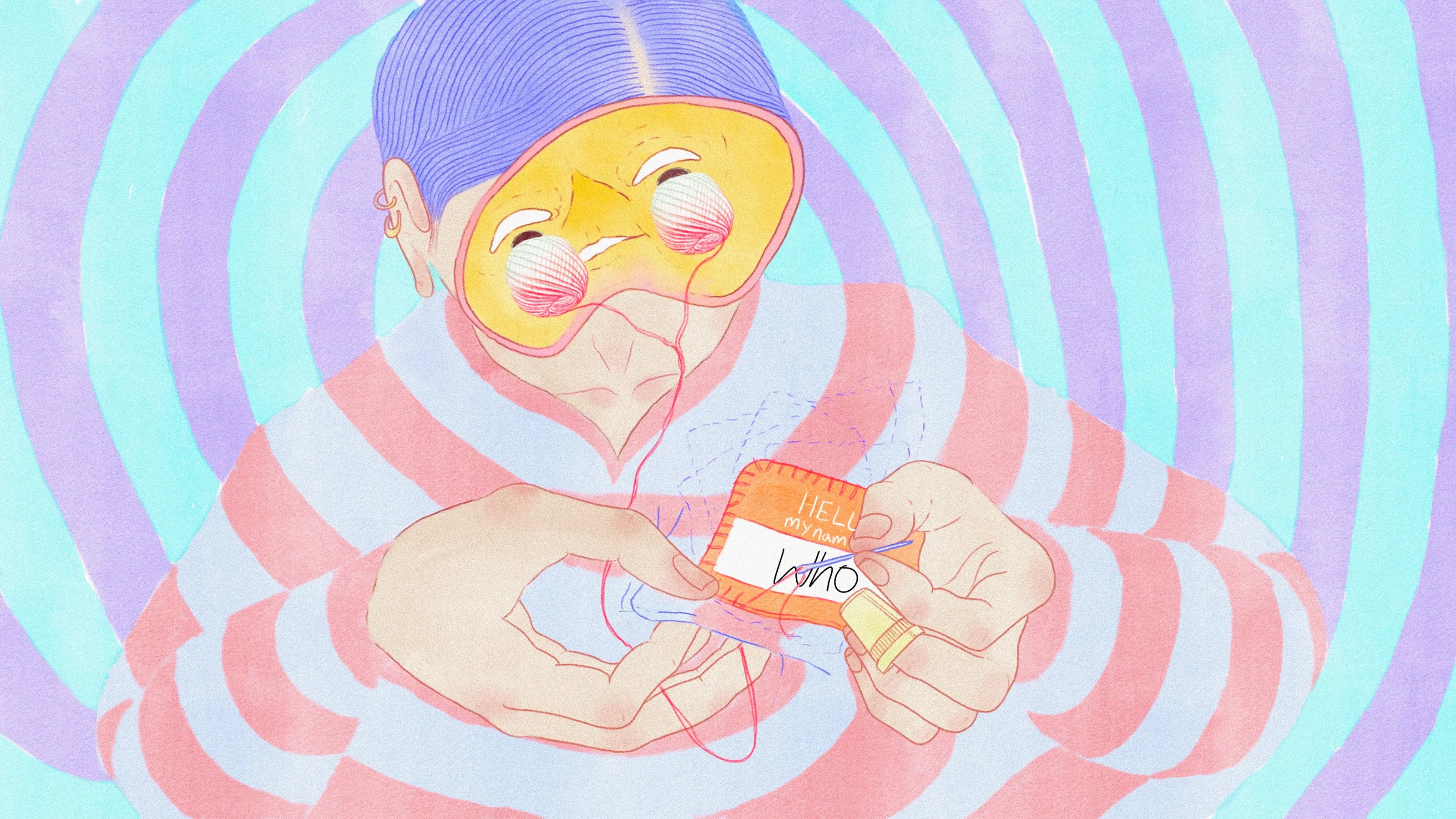


Identity has never been more visible. We list it everywhere: bios, titles, credentials, socials - small signals that tell the world who we are and where we belong. And yet, at the same time, identity has never felt more interchangeable. Algorithms shape what we see, institutions reward predictable signals, and increasingly, the result is a strange paradox: identity is now all-pervasive, while individuality quietly erodes.
Those closest to me know the irony: being in a People Role often means the de-humanisation of people that comes with it. Not in a strip-you-of-your-dignity kind of way, but a I-can't-manage-to-not-look-at-you-as-data kind of way. For me to write about identity, therefore, carries a certain irony in itself.
From ancient philosophers inscribing "know thyself" on temple walls, to Huberman podcasts on identity and goals: we are, dare I say, over-obsessed with the concept. And ourselves. And yet, I can't remember a single time in the last decade where I've felt more weight at our collective mimetic desires, our growing loss of individual identity, and the enmeshment of who we are with what we do - in work and in life.
The work you do. The person you are.
For most of human history, identity formation was not a vanity project. Labels kept us safe, while belonging - to a tribe, a clan, a species and kept us alive. The pull toward homogeneity and group identity isn't a character flaw. It is ancient, deeply wired, and for a very long time, entirely rational. The problem isn't that it exists. It's that we've never built the instinct to grow past it, and now we have technologies that exploit it at industrial scale.
Social psychology tells us that labels and a sense of identity are critical to finding meaning; that we are cognitively architected to favour the groups we belong to, while quietly optimising to exclude those who don't fit our modern tribe. It's no surprise then that most people cling desperately to their labels - as much for their own peace of mind as for the signal they send to the world. "Ex-McK". "Runner". "Founder". "Feminist". "Atheist". Labels to keep us safe. To keep us protected from what happens when each one is slowly stripped away.
At the centre of this, for most high-achievers I work with, is the label that comes from work. Modern professionals, especially those who follow the Startup Gods, don't just do a job. They are the job.
I understand the logic. Founders who have dedicated their lives to one problem. Dancers who have been on their feet perfecting six steps for twelve hours a day, for two decades. Athletes who started at four and have never aspired to less than gold. Identity enmeshment, in those cases, is not a bug. It is the architecture of extraordinary achievement. But most of us are not doing that. We are selling ads, shampoos, and occasionally, productivity tools.
Building a singular core label, something that stabilises and regulates you as a human: is a disservice to the multitudes contained in each of us. It is helpful, and profitable, but never to the individual. Smart organisations create extraordinary employee experiences partly to use this enmeshment as a tool. The courageous ones are transparent about the transaction - blunt reminders that we live in a capitalistic society, with all the abandon that entails. Not nice words. But kinder, ultimately, than the alternative.
I see people collapse, in pain and shame, every single week, as layoffs and life situations lead to loss of work, loss of structure. And most times, this isn't because they're unemployable or lack skills or aren't networked. It has everything to do with the fences they've built, the rigid mental boundaries, the absence of self-worth outside of what they do. To grieve a loss of meaning, and work is meaningful to a lot of us, it consumes us, sometimes disproportionately so - is valid. But to claim it is in service of passion or some higher purpose is not always true. For most people, work is just the easiest available anchor; and a way to avoid discovering who they truly are.
Psychologist James Marcia gave us a useful map for this. He argued identity forms across two axes: how much you’ve genuinely explored, and how firmly you’ve committed, and most people I meet sit squarely in one without knowing it.
Diffusion (neither exploring nor committed): gets a bad reputation, but it isn’t always the worst place to be. For someone whose anchors outside work are strong, it can be stabilising. Increasingly, I see many Gen Z professionals map here: some by circumstance, others by conscious design.
Foreclosure is where things become quietly dangerous. High commitment, low exploration: the person who is utterly convinced of what they are, without ever having genuinely questioned it. I meet them constantly. They hate their manager, their industry, their life, yet cannot imagine being anything other than what they already are. The identity was handed to them by circumstance, expectation, or the first job that told them they were good at something.
Moratorium (exploring without committing): is the ideal quadrant for a graduate, a curious high achiever, anyone mid-transition. It is also the quadrant we most aggressively discourage. Personal risk tolerance, parental expectations, financial obligations, and social shame around being a work-in-progress all push people out of moratorium before they’ve had the chance to learn from it.
Achievement (the world’s favourite): is where labels often come back to haunt people. The more tightly you attach yourself to outcomes, status, and the attributes society rewards, the harder it becomes to remain curious, authentic, and free. You get promoted for being decisive, not for being in process. Identity achievement, can also dangerously resemble foreclosure, with better labels.
In a world that has never made it easier to outsource identity formation, to algorithms, to AI, to the mimetic pull of what everyone around you appears to want, the question is no longer just whether you know who you are. It is whether you have done the thinking required to find out.
The Last Man and the Algorithmic Herd
Nietzsche wrote about a figure he called the Last Man - a person who has solved all of life's friction. He sleeps well, eats well, works fine, has opinions that match his peer group, and cannot tell you the last time he was genuinely surprised by himself. He's not unhappy. That's the problem. He has optimised away everything that would have made him interesting, including himself. The Last Man is not a cautionary tale about bad people. It is what happens to good people when every friction is removed, every identity question is answered by a label that can be bought or performed.
Writing this took me nineteen starts across eleven days. Not because I lacked opinions, unfortunately, I have too many. Because I had become so accustomed to optimising for time and inertia that I couldn't sit with myself for more than five minutes at a stretch.
I could happily name my first-born Claude. I've never been more excited about what AI makes possible in my function. But having a front-row seat to watching smart people struggle to hold an individual opinion, practice judgment, and resist the pull toward apathy, feels very dystopian to be quite honest.
The more perfect the holiday pictures, pilates planks, concert ticks, the more popular the "unpopular opinion"; the more we see facades operating as identities, and mental breakdowns aired for the validation that should have come from somewhere internal.
Psychologist Daryl Bem argued we infer who we are from watching our own behaviour, the same way we'd read a stranger. If your behaviour is curated for an audience, what exactly are you learning about yourself?
The Mighty Ship of Theseus
A friend and I argue constantly about meaningful journeys v meaningful outcomes. We've never moved each other an inch. But we agree on one thing: the ability to hold two opposing ideas simultaneously, to start over, to stay grounded in what you actually believe even as the shape of it keeps changing. Identities work this way too, or rather, they should. They exist to serve the life you want to live, not the other way around.
The Ship of Theseus question is usually: if you replace every plank, is it still the same ship?
The more interesting question is who is doing the replacing, and why? If every new version of you is the currently approved upgrade <new favorite philosophy, new wellness stack, new aesthetic> you're just conforming.
And the update cycle is fine, until it isn't. Until the label is removed. The job ends. The company folds. You grow older and the market stops finding the identity you built quite so valuable. You get divorced. Your parents are aging. Your friends don’t “feel” the same anymore. What then?
Most people discover, only at that point, that the label was not a reflection of who they are: it was a replacement for the question. The people who collapse hardest after redundancy, after a career pivot, after any significant external loss; are rarely the ones who lack skills. They're the ones who never built an interior life that existed independently of the role.
It matters more than it sounds. The polymath in her thirties who can't find her footing because she built her identity around being interesting rather than learning to adapt in a slow growth role. The person who can't take a sabbatical, savings and all, because rest has no place in a high-achieving identity, leaving her jaded and cynical. The young recent grad, who cannot take feedback because their entire sense of self runs on external validation as fuel.
The most interesting people I know insist on writing analog, on learning things that don't belong to their category, on watching art that makes them uncomfortable. Not as optimisation. Because cognitive and emotional effort - is the only way out. The process of creating - long relationships, meaningful projects, long distance friendships, a strong body, a curious mind - they take emotional resilience. It is tiring, exhausting, to give a damn. And that maybe the last bastion of hope in preserving our individual identity.
I am a rock, I am an island..but mostly we’re all just phone screens
A few years ago I took my fourth sabbatical. No agenda, no productivity arc, no skill I was quietly acquiring. Just time - eating, sleeping, family, Netflix, massages, museums, plays, picnics. And the most interesting thing about that period wasn’t anything I figured out about myself. It was watching how uncomfortable other people were with someone who had, temporarily, no current label to offer. A person without a live title, it turns out, is faintly unsettling. I found that more revealing than anything I could have optimised for: the way others projected their anxiety on me, and the way they immediately responded with “suggestions” on how my days could include more of whatever it is they valued.
Because here’s what nobody says plainly: not performing is no longer neutral. It’s an act of rebellion, and it costs you something real. I’ve been in rooms I wasn’t let into. Passed over for people with tidier signals and less interesting minds. I’ve watched credentials do the work that thinking was supposed to do, and I’ve watched it work consistently, frustratingly well. The label wins, more often than I care to admit.
And yet, we are arriving, faster than most people realise, at a moment where knowing who you are, underneath the title, the signal, the polished summary, is no longer just philosophically interesting, it’s a survival skill. The professional with the AI-assisted opinion and the algorithm-shaped personality isn’t lazy; they just never built the thing underneath, the judgment, the taste, the point of view that is genuinely and stubbornly theirs.
And that thing, deeply unfashionable, impossible to automate - is the only thing that will matter in rooms where everything else has been generated.
This Ship of Theseus has no destination. And sometimes, neither should we.
EDITOR’S NOTE
When Mitasha told me what she wanted to explore with Identity and Expression, I knew it had to be piece introducing the world to our latest volume. It's very similar to a piece Nisha, our previous editor, had written about enmeshment and work a couple of years ago. Not only does Mitasha's piece take off from where Nisha ended her piece, but also captures the general uneasiness, angst, and impatience prevalent among the workforce today. Her piece forces us to ask ourselves the uncomfortable question of when our expression of identity becomes a charade amidst this status-seeking, label-obsessed, and transactional world.


.png)
.webp)

%20(1).jpg)
.png)


.svg)


